

Chapter Two, Part Two
My Man Griffin; 'Greasing' Palms

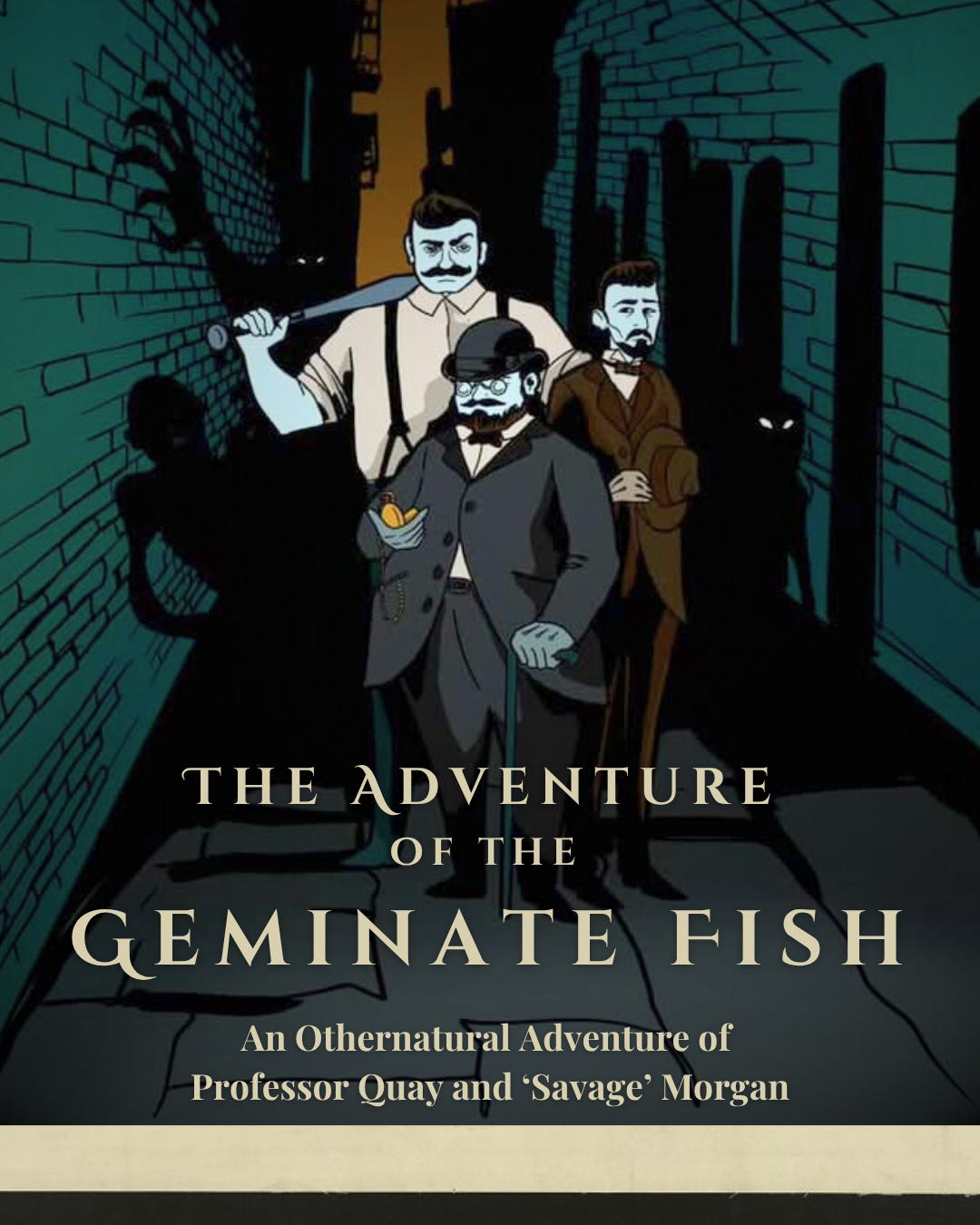
My Man Griffin
In the immediate aftermath of the disagreement, even before the arrival of the police, our company was increased by one. Sullivan had locked his study door behind us, but the lock was a small impediment to my “shadow”—Lewis Griffin, the young man Shlomo had tasked with “keeping an eye on me.” A lean, even scrawny fellow, Griffin had mastered the effect of appearing innocuous on the streets of Manhattan by having spent all of his life on the streets of Manhattan, for he was one of countless orphans created by the War, having lost his parents at such a young age that he could not remember them or his situation prior to whatever disaster took them.
In his twenty-odd years of life, Griffin had been a newsboy, a stable hand, a “brothel boy”—an occupation not nearly as glamorous or as amorous as one might imagine—and, most successfully, a lookout for any number of gangs, sharpers, burglars, pimps, confidence men, and Shlomo himself. These experiences had given the young man many skills and many scars. He was not a bold fellow and was near useless in a tussle, being only slightly slower to surrender to a threat than Professor Quay himself was. But he was immensely loyal and patient, and had been with my aunt’s organization long enough that the notion of disobeying her or Shlomo would never cross his mind—or so I believed that night at Sullivan’s.
Griffin let himself into the apartment and stayed out of the way until Morgan had concluded his pacification of Sullivan and his men, keeping an accurate count of any rascals who escaped—two—but not interfering with their departure. He was also the first man the police saw upon their arrival, and while not as well known among the hundreds of officers who patrolled the island as Shlomo or me, more police officers than not knew Griffin on sight and, upon seeing him, understood that whatever the disturbance, the Witch Queen of Fifth Avenue’s interests were involved.

‘Greasing Palms’
Mr. Sullivan kept up his shouting until the police arrived. He then redirected his assault at the sergeant, but his verbosity did him no good. Professor Quay was on excellent terms with the police of the district, having assisted them on cases too numerous to mention. The sergeant thumped Sullivan when he refused to be quiet and then arrested him when he tried to run.
Here I rose to the occasion, bringing the details into focus for the sergeant and his men. There were a few timely corrections or additions from the professor, and all too many interruptions from Morgan, but in the end, I think the sergeant understood the gist of the affair. Sullivan and his accomplices were carted off to the jailhouse or hospital, as their condition dictated, and the sergeant declared us free to go. Professor Quay signaled me, and I clandestinely pressed a gratuity into the sergeant’s hand—a small amount, nothing near the outlandish payoffs of the Tweed days—but still enough for him and his men to enjoy a hearty lunch and a few beers on us. Such generosity kept our dealings with the police smooth on this level. More money might be needed if Sullivan had been paying out for protection from another quarter, but we would have to wait and see what—if anything—came of Sullivan’s many threats of “connections.”
Meanwhile, the other officers were engaged in barbed repartee with Morgan, whom they had arrested a dozen times and had nicknamed “Savage.” Morgan’s replies were more vulgar than witty, but neither party was eager to take the confrontation beyond words. Readers will remember that even Boss Tweed had been polite to the professor through our many dealings. The need for a trustworthy paranormal detective may arise only very rarely, but when it did, Professor Peter Phineas Quay was the finest in New York City, if not the world—an appellation that the events of the next few weeks would spectacularly reaffirm—and the important persons of the city and state of New York were keen to have the professor amenable to their requests.
We shared a coach back to the professor’s 10th Avenue residence, Morgan chattering nonstop, as was his habit after action, while Professor Quay sat in silence, his mood falling as it always did when we uncovered another fraudulent medium. Griffin did not ride with us, he and Shlomo being of the opinion that I should never be aware if I were being “guarded” or not.
Morgan’s talk was all over the place, as was typical. He spoke of the fight he had just had: “I taught that idiot never to mess with a Navy man, that’s for certain.” He spoke of fights he had been in before today: “In that instance, that little dodger was a quick one, and he got the knife into me…” And he spoke of fights he might have in the future: “On ship we had belaying pins, at least. A man didn’t have to bruise his knuckles as I’ve done today. Next time out, I’m bringing a roundball bat,” and so on.
My pet hate of Morgan, although disapproved of by the professor, had solid roots: the man was oft times unbearable.
When we arrived at the professor’s home, I could see that he had company. The impressive black brougham owned by Colonel Broome was hitched outside, the two midnight geldings that drew the colonel’s carriage putting our poor dappled taxi mare to shame. I heard the professor give a long sigh, for while he was something of a night owl and two a.m. was not an unusual hour to find him awake, I don’t imagine that any of us were excited by the notion of an early-morning visit from the boisterous, occasionally overbearing Colonel Herbert Broome.
Thank You for Reading
Part Six Posts Wednesday December 3rd